
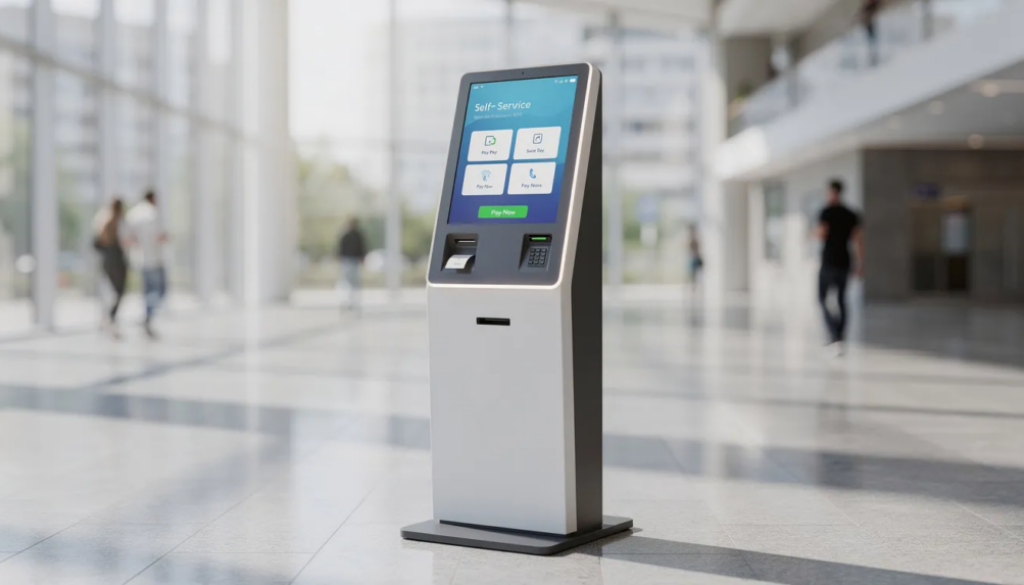
How On-Screen Kiosk Advertising Can Support Revenue and Customer Communications
A self-service payment kiosk does not have to be limited to completing a transaction. When its screen is configured carefully, it can also act as a controlled communications touchpoint, giving organisations a way to share useful information with people who are already interacting with the kiosk.
For hospitals, councils, charities and other organisations, kiosk advertising can support campaign messages, service information and brand visibility without introducing a separate display. On our kiosk benefits page, we identify optional on-screen advertising as a potential additional income opportunity, while our product range supports customisable graphics and screen-based communications.
What is kiosk advertising?
Kiosk advertising is the use of screen space on a self-service kiosk to display promotional, informational or branded content alongside the kiosk’s main function. In a payment environment, that main function should remain clear and easy to complete. Advertising or communications content should support the user journey rather than compete with it.
This is slightly different from conventional digital signage. A standalone digital display exists mainly to show content, whereas an advertising kiosk is first and foremost an interactive service point. That makes context especially important. People are approaching the screen to complete a task, so any additional message needs to be concise, relevant and easy to understand.
How on-screen kiosk advertising can support customer communications
Use a screen where attention already exists
A kiosk gives an organisation a digital touchpoint in a physical location. Rather than asking customers, patients, residents or supporters to notice another poster or display elsewhere, useful information can be presented on a screen they are already using.
Depending on the setting and the way the interface is configured, messages might include service updates, campaign information, event details, awareness content or other practical notices. On our charity kiosk page, for example, we explain that custom graphics can be used for marketing messages, event dates and other information between donations.
Reinforce campaigns and brand messages
Branded kiosk advertising screens can help organisations keep visual identity and campaign messaging consistent at the point of interaction. This can be particularly useful where a kiosk supports a wider service, fundraising campaign or customer journey.
Some organisations searching for branded kiosk display advertising screens are effectively looking for the same capability: a self-service screen that can carry approved branded content without making the transaction process harder to use. The priority should be consistency and clarity rather than filling every available part of the display.
Keep communications relevant to the location
The most useful on-screen messages are usually those that make sense in the setting where the kiosk is installed. A charity may want to promote an upcoming appeal or explain the impact of donations. A council may want to signpost a service or digital resource. A healthcare organisation may want to display approved service information or a hospital charity message.
Keeping content relevant also helps prevent the screen from becoming visual background noise. A short, timely message is more useful than a rotating collection of unrelated promotions.
Can kiosk advertising create an additional revenue opportunity?
We describe optional on-screen advertising as a way organisations can generate additional income from their kiosks. This should be treated as an opportunity rather than a guaranteed revenue stream, because the commercial value of screen space will depend on the organisation, location, audience and its own advertising policies.
An organisation may decide that approved partner or sponsor content is appropriate for part of an advertising kiosk display. Others may prefer to reserve the space entirely for their own campaigns and service messages. In either case, the primary user journey should remain dominant.
We do not need to sell advertising on behalf of an organisation for the screen itself to have value. The underlying opportunity comes from having configurable digital space on a device that already serves an operational purpose.
What content works well on an advertising kiosk display?
Useful content will vary by organisation, but suitable examples can include:
-
service notices and practical information;
-
campaign or event promotions;
-
charity appeals and impact messages;
-
awareness campaigns relevant to the location;
-
approved partner or sponsor messages, where these fit the organisation’s policies; and
-
clear calls to action that direct users to an appropriate next step.
Content should be brief enough to understand quickly. Dense paragraphs, multiple competing calls to action and constant animation can distract from the kiosk’s main purpose.
Designing branded kiosk advertising screens around the user journey
Keep the transaction first
An advertising kiosk display should never make it harder for somebody to complete the task they approached the kiosk to perform. Payment options, donation choices or service selections need clear visual priority.
Advertising can sit outside the main interaction area, appear when the kiosk is idle, or be shown at suitable points in the journey, depending on what the configured interface supports. The exact approach should be agreed as part of the kiosk design rather than added without considering usability.
Make messages easy to read
Screen content should use clear language, legible type and strong visual hierarchy. Important information should not rely on decorative graphics alone. Organisations should also consider accessibility requirements and test the interface with the people who are expected to use it.
Put governance around content
Where several departments, partners or campaigns want access to the same screen, it helps to define who owns the content, who approves changes and how outdated messages are removed. This is especially important in public-sector and charity environments, where communications may need to follow existing organisational policies.
Using kiosk advertising across different sectors
Charities
A charity donation kiosk can combine the donation journey with communications about current appeals, upcoming events or the organisation’s work. On our charity kiosk page, we explain that custom graphics can be displayed between donations and that on-screen advertising can be used as an additional revenue opportunity.
The screen can therefore support both fundraising and communication, provided the donation process remains straightforward and the content is kept current.
Healthcare organisations
In a healthcare setting, kiosk screen space can be used for approved service information, hospital charity messaging or other communications relevant to the department. The content should be appropriate to the environment and should not obstruct the payment or self-service journey.
Councils and public services
Councils can use kiosk screens to signpost services, digital channels, public information or relevant campaigns. Where advertising is considered, the organisation should determine what content is appropriate under its own governance and communications policies.
Other organisations
Private-sector organisations, visitor attractions and other venues may also use kiosk screens for promotions, event information or customer guidance. The same principle applies: the message should add value without creating friction in the main interaction.
How to measure whether kiosk advertising is useful
Before adding advertising or communications content, decide what the screen is supposed to achieve. A revenue objective requires a different measurement approach from a service-information objective.
Possible measures might include visits to a campaign page, responses to a specific call to action, use of a unique QR code, event enquiries or feedback from staff and users. Only use measures that the organisation can genuinely track. Transaction reporting should not be treated as evidence that somebody viewed or acted on an advert unless the setup specifically supports that conclusion.
Regular reviews can then identify content that should be retained, updated or removed.
How we support kiosk communications
Our product range includes kiosks with customisable graphics and screen-based communications. Our benefits and charity pages also describe optional on-screen advertising, custom interfaces and the ability to display marketing or event messages.
This allows organisations to consider communications as part of the kiosk design from the outset rather than treating the display as a fixed payment screen. The exact layout and content should still be shaped around the organisation’s requirements, audience and internal approval process.
Kiosk advertising is most useful when it has a defined purpose. Used carefully, the screen can support customer communications, reinforce campaigns and provide an additional income opportunity while the kiosk continues to perform its primary self-service function.